
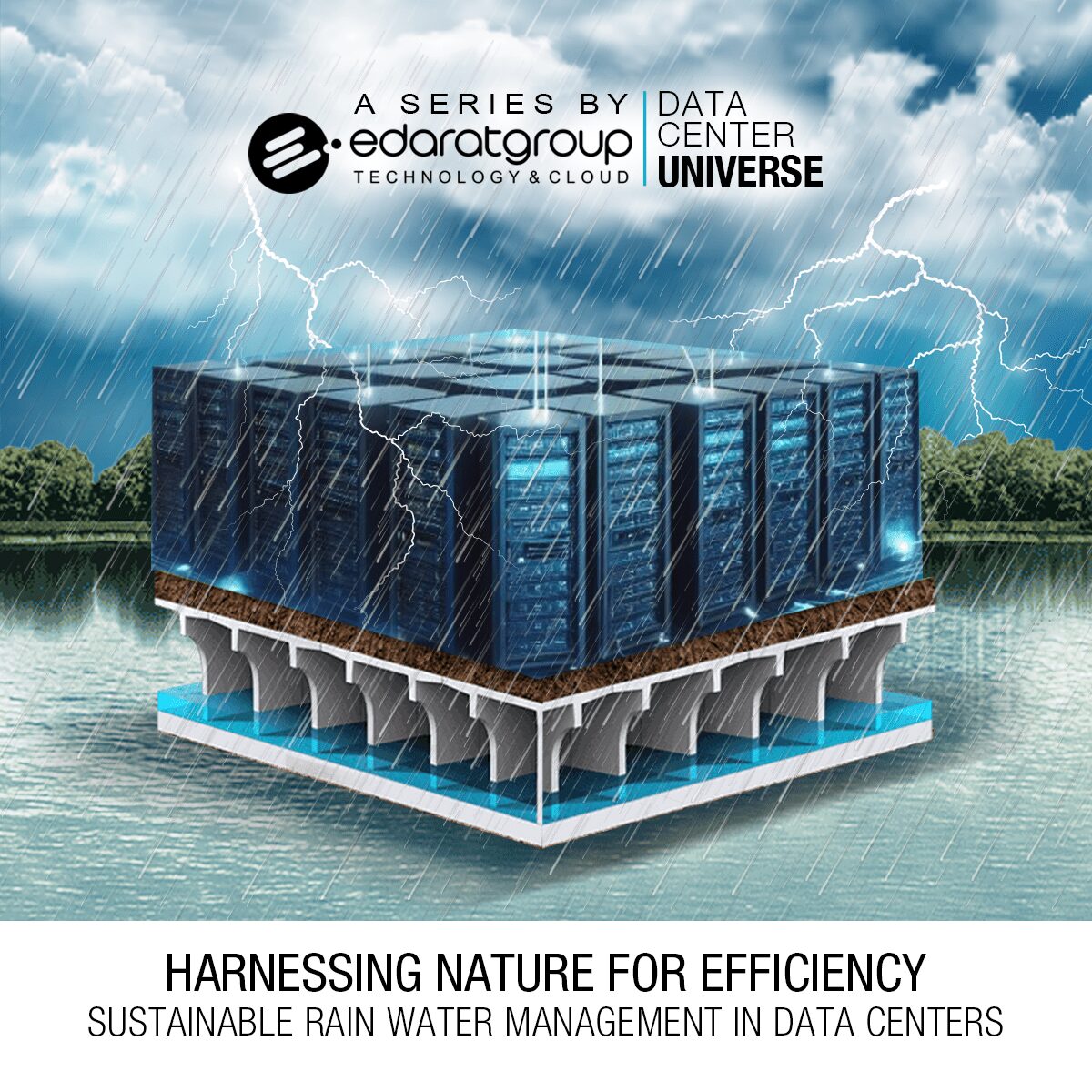
Data Center Sustainable Rainwater Management

Mohammad AlRawas

Sustainability Lead Specialist

Edarat Group

🌍 Is your Data Center Site Sustainable?
To begin, it’s essential to define sustainability accurately. It involves meeting our own needs without compromising the ability of future generations to meet theirs. These needs encompass natural, social, and economic resources. When talking about sustainability, we refer to the “Triple Bottom Line” or 3P’s, which are:
🌱 Planet as Environmental Stewardship 👥 People as Social Responsibility 💰 Profit as Economic Prosperity
When developing data centers, the journey toward sustainability begins with selecting the project site. However, the site selection process is influenced by various and multiple criteria, including but not limited to:
🛡️ Safety and security 🌧️ Flooding Simulation (Pluvial, Fluvial) 🌊 Avoid lands with aquifers (Groundwater) 🏙️ Surrounding Density and Diverse Uses 🌍 Earthquakes and other natural hazard events 💧 Existing Water, Sewer, and Stormwater networks
In most of the countries, local codes and Environmental regulations exist to prevent development that disturbs or located near sensitive lands, which are but not limited to:
🌾 Prime Farmlands 🐾 Natural Habitat 🌊 Water Bodies 🏞️ Wetlands
Accordingly, during the pre-design phase, the data center sustainability engineer shall conduct site surveys and assessments of the available natural resources to develop an “Environmental Impact Assessment” report demonstrating that any development will not negatively impact any of the available natural resources on or in proximity to the selected site. One of the most important aspects and parameters to be considered during the early design stage is the site’s hydrological pattern and rainwater precipitation volume based on available historical data. And accordingly leveraging these patterns to reduce water consumption for cooling and humidification and to preserve the natural land cover hydrologic regime of watersheds. In this regard, the data center sustainability engineer shall adopt environmentally sustainable rainwater management systems such as Green Infrastructure GI and Low-impact Development LID strategies to retain, on-site, no less than 95th percentile of rainwater runoff volume. Examples of these strategies include:
🌱 Maximizing pervious land covers and pavements to promote rainwater infiltration 🌧️ Rainwater harvesting through on-site Geocell tanks, which reduce the stress on external rainwater networks 🌳 Preserving vegetation and increasing soft landscape areas
Normally the data center sustainability engineer conducts a preliminary water budget analysis to support effective design decisions and potential integrative design opportunities, by gathering data to quantify the project’s potential non-potable supply sources such as captured rainwater, graywater from flow fixtures or condensate from cooling equipment. Following the preliminary water budget analysis, the data center sustainability engineer will conduct a complete life-cycle cost assessment for the different on-site non-potable water supply source alternatives considering the following for each alternative:
💵 Initial capital cost ⚙️ Operating cost 🔄 Resilient Design 🛠️ Maintenance cost 🚮 Disposal cost ⏳ Lifespan 🌿 Embodied carbon emissions
The best engineering practices for water management start by eliminating the water demand whenever possible (Air-cooled chillers, for example) or by reducing it to the minimum by adopting low flowrate fixtures (e.g., WaterSense Label), selecting native plants with limited water irrigation requirements, and installing intelligent irrigation controls for landscape management. The following are the best practices for water management and/or conservation, starting from the top with the most preferable down to least:
1. Eliminate 🚫 2. Reduce 📉 3. Reuse 🔄 4. Treat/recycle and reuse ♻️ 5. Disposal 🚮
💧 Water as a Natural Resource
Only 3% of the Earth’s water is fresh. Out of that 3%, slightly over two-thirds is trapped in glaciers. According to these figures, freshwater demand is expected to outstrip supply by 40% by the end of this decade. In the U.S., buildings account for 13.6% of potable water use, which is considered the third-largest category behind thermoelectric power and irrigation. Water stress and demand will continue increasing if governments, industry, and non-governmental organizations do not take strict and clear action. In addition, the energy required to treat water for drinking, transport it to and from a building, and later, treat it for disposal represents a significant amount of energy use not captured by a building’s utility meter. Thus, the water crisis is increasingly intertwined with global warming and the loss of biodiversity, with each reinforcing the other. A key driver of this phenomenon is global warming, which creates a global energy imbalance that intensifies the water cycle, adding approximately 7% more moisture for each 1°C rise in global mean temperature. Additionally, land use changes — such as deforestation, wetland depletion, land degradation, and infrastructure development — are now affecting precipitation patterns and the distribution of rain between green water (soil moisture/vapor) and blue water (runoff/liquid) flows. Given these facts and the mismanagement of water sources, it is imperative that all relevant stakeholders become involved to take corrective actions for serious and effective water resource management. Specifically, in the data center industry, designers and builders should consider constructing green buildings that use significantly less water than conventional constructions. This can be achieved by incorporating native landscapes that eliminate the need for irrigation, installing water-efficient fixtures, and reusing rainwater and wastewater for non-potable water needs. The Green Building Market Impact Report (2009) found that LEED projects were responsible for saving an aggregate of 1.2 trillion gallons (4.54 trillion liters) of water.
DATA CENTER UNIVERSE (7th Publication): Sustainability Reporting Guide
🏢 Data Centers – Thirsty Facilities
Data center facilities are energy-hungry and resource-intensive, consuming a huge amount of energy and water, mainly for cooling systems that maintain the required operating conditions. One of the main important sustainability metrics related to data center operations is Water Usage Effectiveness (WUE), which has become one of the hottest topics besides Power Usage Effectiveness (PUE). Significant progress has been made in the last 10 years to improve the Power Usage Effectiveness (PUE) and energy efficiency of DC cooling systems. Some of these efficiency gains have been achieved by using advanced energy-efficient systems. Yet, energy efficiency gains and improvements in PUE came at the expense of large water consumption, which contributes to stress on the water supply. Water Usage Effectiveness (WUE) is one of the main efficiency metrics used to measure a DC’s sustainability and efficiency, along with PUE and Carbon Usage Effectiveness (CUE). Thus, seeking alternative renewable water sources that serve the facility cooling infrastructure is currently considered one of the main objectives during the predesign stage. Furthermore, researchers at the University of California, Riverside, have found that between 5 and 50 ChatGPT requests can consume up to 500 milliliters of water. Google’s increased AI development in 2022 resulted in a 20% increase in water consumption compared to 2021 metrics; in the same period, Microsoft reported that it consumed 34% more water. By 2027, the amount of water AI will consume in one year worldwide is projected to be on par with what a small nation consumes. Consequently, the water consumption by AI data centers is expected to increase, and seeking alternative renewable water resources such as water harvesting is essential to reduce the environmental impact.  To date, only a few technology companies have taken steps to apply what might be the simplest, most proven and most promising strategy to mitigate water risks: catching rainwater from the sky. In this regard, rainwater harvesting and reuse is considered one of the most sustainable water sources serving the cooling systems, in addition to its economic benefits especially in the areas where municipal and water utility source is considered expensive. Some industry leaders are recognizing the potential of rainwater harvesting:
🔵 Microsoft announced it will be water-positive by 2030, which means it will replenish more water than it consumes by implementing rainwater harvesting in Sweden, reducing reliance on local water sources. 🔴 Google Data Center in South Carolina utilizes rainwater retention ponds for harvesting. 🟧 AWS: Amazon Web Services also highlighted the potential of rainwater harvesting in its water-positive strategy for 2030.
According to research carried out by Savills, it is thought that a data center may use up to 26 million liters of water each year, on average, per megawatt of data center power, which might not be covered by harvested water. However, with climate change and rising costs of water, the benefits of a water harvesting system also increase. Data centers’ large, flat roofs are ideal for rainwater harvesting. A 50,000-square-foot roof can collect approximately 31,000 gallons of water from just one inch of rain. Many data centers feature roofs larger than 100,000 square feet, and some hyperscale data centers feature roofs up to a million square feet. Rainwater harvesting consists of the collection and storage of rainwater, usually from roofs and MEP yards. It also involves filtering processes to remove solids, organic materials, and sediments. This includes water treatment to neutralize nutrients and bacteria for evaporative cooling and/or humidification use. The level of treatment required depends on:
🧪 The water collection area 🔬 The level of contaminants ❄️ The type of cooling used – single pass or recirculatory ⏳ The storage period before use
DATA CENTER UNIVERSE (6th Publication): ACC: Best Choice for Hot Climate
🌿 Sustainable and Green Data Centers
One of the key drivers underpinning the growth in green data center appetite is from “Hyperscalers” such as Amazon Web Services (AWS), Microsoft and Google. As an example of hyperscalers commitment to sustainability, AWS has over 400 renewable projects globally, while Google has recently committed to its data centers being 100% carbon neutral by 2030. Given this, the explosion of big data hyperscalers will likely see green data centers play a critical role in the digital revolution. Given the attractiveness of green data centers, the global market’s rapid growth is expected to continue. Total investment in green data centers globally reached an estimated US$35 billion in 2021, and by one forecast, is set to rise by over 7.5% per annum to US$55 billion by 2027. Regarding rainwater harvesting systems, the market serving newly built facilities was valued at 1 billion USD in 2024 and is projected to reach 1.6 billion USD by 2031 at a CAGR of 5.89% from 2024 to 2031. According to “Verified Market Research,” North America is estimated to dominate the rainwater harvesting market over the forecasted period. Furthermore, rainwater harvesting is increasingly incorporated into urban planning and green construction designs. In 2023, the US Green Building Council stated that 70% of LEED-certified buildings in North America used some sort of rainwater harvesting system, a 25% increase from 2021. Also, the American Society of Civil Engineers reported that urban development projects using rainwater harvesting technologies grew by 50% between 2020 and 2023, owing to municipal sustainability goals and water management rules. Sustainable rainwater management systems are considered one of the major drivers toward increasingly sustainable data centers. This collaborative process involves various key players and stakeholders, including regulators, owners, engineers, vendors, and manufacturers. Despite implementing various programs, regulations, initiatives, and technologies, it is still not enough to achieve the goals set by green data centers to reduce environmental impact and maintain natural hydrology and water balance. Future green data centers should adopt sustainable rainwater management systems and strategies for harvesting, filtration, infiltration, capture, and reuse due to their economic, social, and environmental benefits.
DATA CENTER UNIVERSE (5th Publication): Data Center Liquid Cooling is Here

Share this post

Mohammad AlRawas

Sustainability Lead Specialist

Mohammad AlRawas has more than 12 years of experience in the construction field and critical-mission project delivery. He is currently leading the delivery of cutting-edge sustainability, zero-waste, and energy management technologies and best practices in the data center industry at Edarat Group—Data Centers Engineering Services. He’s ensuring the implementation of green building rating programs strategies like LEED and TRUE certifications.

Stay ahead

Is Your Data Center Site Truly Sustainable?

Sustainability isn’t just a buzzword; it’s about balancing environmental, social, and economic needs. At Edarat Group, we design smarter, greener data centers that harness solutions like rainwater harvesting to cut water waste and boost efficiency.