

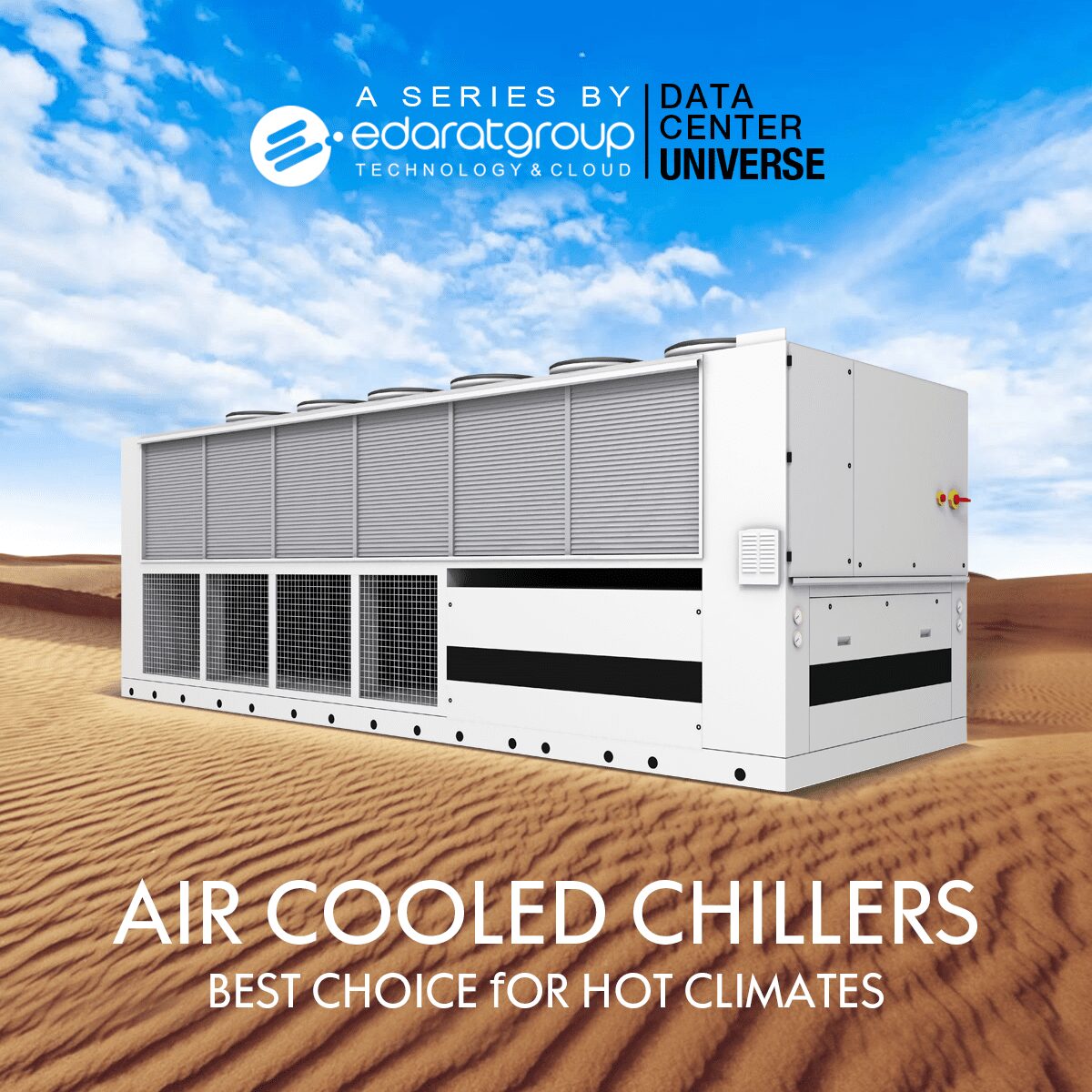
The primary goal of data center cooling technology is to sustain optimal environmental conditions for IT equipment (ITE), which mandates selecting the most suitable cooling solution based on cost, efficiency, reliability, and sustainability.
Air-cooling OEMs (in white space/indoor environments) recognize the increasing move toward liquid cooling solutions. “Air has limitations in its heat dissipation capacity, which maxes out at around 30 kW per rack (10 kW per m²). Beyond this threshold, liquid cooling becomes necessary.”
High-performance computing (HPC), AI (Artificial intelligence), Internet of Things (IoT), data analytics workloads, other emerging technologies and similar applications indeed require liquid cooling; however, it has been demonstrated that much of the heat generated will still be expelled to the atmosphere through traditional air-conditioning systems, as has been the case with data centers since their inception. Liquid cooling methods such as rear door heat exchangers, cold plates, and direct-to-chip cooling can be fully integrated with air-conditioning systems. It is also likely that immersion cooling will follow this trend due to recent recommendations for acceptable fluid temperatures, now set at 27°C, a change from the 40+°C previously recommended by ASHRAE in 2011.
Therefore, whether data centers use indoor air cooling or liquid cooling, the outdoor heat rejection systems remain unchanged. They continue to rely on existing air-cooled, water-cooled, and dry-cooled chillers and other traditional mechanical cooling solutions such as Direct Expansion (DX).
Therefore, the primary objective of this Data Center Universe series is to recommend the most suitable mechanical outdoor heat rejection system for regions with limited water resources, such as the Kingdom of Saudi Arabia.
As the data center industry moves toward larger, often hyperscale environments, cooling strategies are evolving to accommodate the demands of these expansive facilities. DX systems, with chillers continue to be an effective solution for high-capacity data centers. However, these systems vary across a spectrum types, and the selected configuration will influence the facility’s cooling technology.
In the data center industry, it’s widely recognized that air-cooled and water-cooled chillers have dominated the market. However, with the rise of large and hyperscale data centers—handling loads around 100MW—1GW—and the focus on optimal temperatures for liquid cooling systems over the past decade, some OEM manufacturers introduced a new type of chiller to the market. This chiller is referred to as a high-temperature chiller with Free Cooling capability or a high-temperature compressor-assisted Chiller.
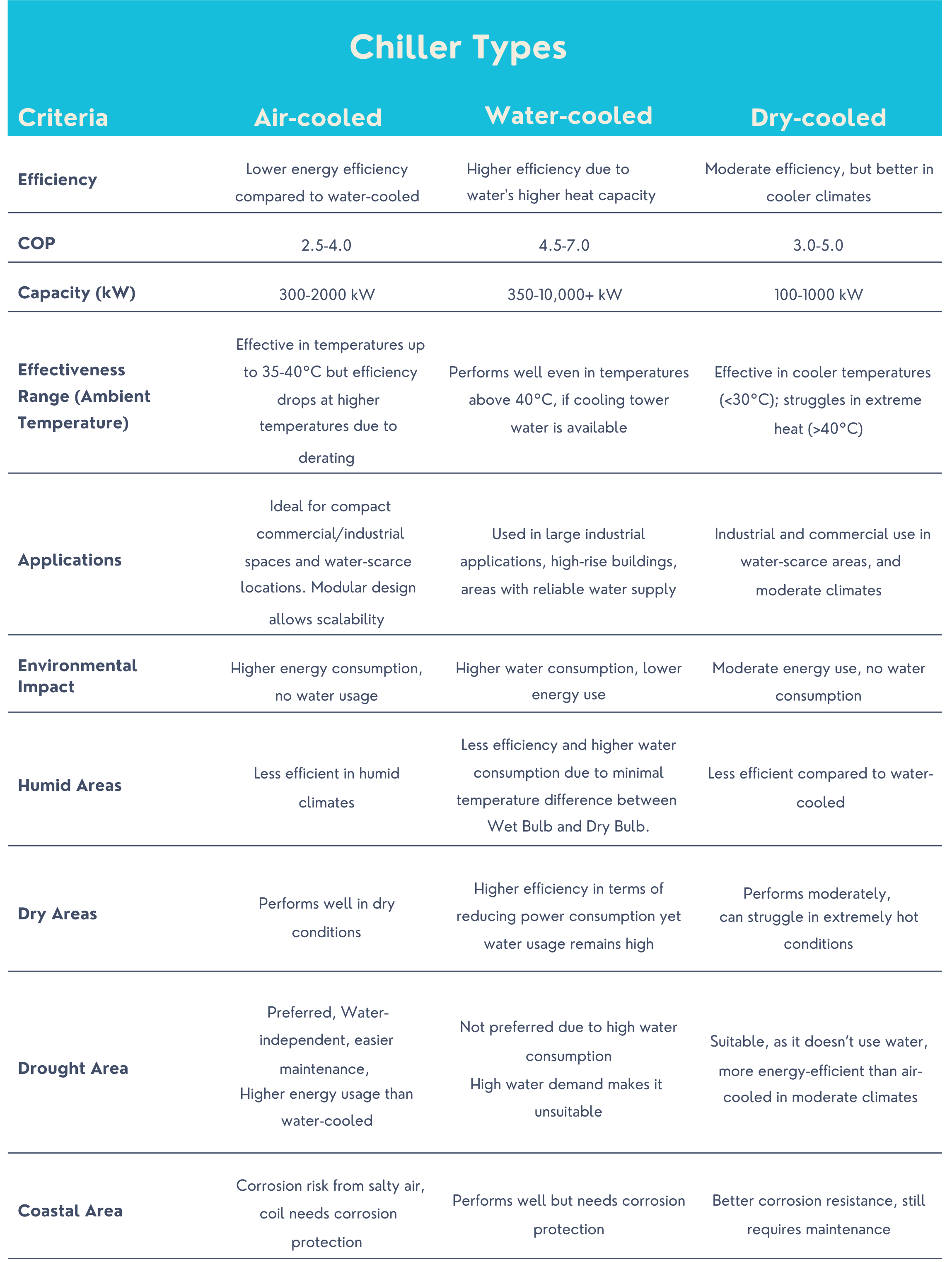
The following table compares the two dominant air-conditioning systems and the dry cooler, excluding other systems, as high-temperature solutions are unlikely to be widely adopted. It clearly indicates that Air-Cooled Chillers (ACC) are recommended in water-stress areas, even for legacy data centers, considering the projected growth in IT load and future data center requirements.
Cooling towers are essential components for the Water-cooled Chillers. A cooling tower that supports around 1 MW of IT load can weigh up to 7,500 kg when operating. Accommodating this load and the associated piping on a rooftop or elsewhere introduces considerable engineering complexity and increased costs. Alternatively, ground-level placement raises concerns about air plumes and associated health risks, particularly the potential for Legionella Disease.
For facilities exceeding 10 MW, the operational weight of the cooling towers can reach approximately 75,000 kg, with additional load demand driving further increases in weight. This makes the construction and installation of such cooling towers increasingly challenging, particularly when factoring in the need for redundancy and adherence to concurrent maintenance and redundancies, which introduce further complexity to the design and implementation.
Maintenance of water-cooled chillers and cooling towers is even more complicated and needs highly qualified personnel and continuous follow‐up for various equipment and system components such as condensate pumps, water tanks, and makeup water systems. Regular treatment of condenser water is required to eliminate the growth of algae or bacteria.
Water is a precious resource, becoming scarcer and more valuable by the day as studies suggest global water usage will increase by as much as 30% in the next few decades. Hyperscale data centers as large as 100MW in capacity use hundreds of thousands or even millions of gallons of water every day, which puts a tremendous strain on municipal water and treatment plants to reliably supply that amount of water, especially if the source of water is provided from desalination plants.
Like electrical utilities, the increasing demand from such high ITE loads is expected to significantly strain commercial water utilities, particularly in regions with limited water resources. This stress will likely raise the water costs per cubic meter. Unlike electricity, where facilities can mitigate this demand by building on-site power generation plants for large data centers, water supply lacks a comparable alternative solution, intensifying the challenge for water utility providers.
DATA CENTER UNIVERSE (5th Publication): Data Center Liquid Cooling is Here!
Operating evaporative cooling systems requires expertise in water chemistry, as dissolved minerals can negatively impact equipment performance and efficiency. As water evaporates, mineral concentration increases, requiring a “blowdown” or bleeding process, where old water is drained and replaced with fresh makeup water. Warm, dirty condenser water also encourages bio-growth, potentially damaging heat exchanger surfaces. Failing to meet basic water chemistry and quality standards may result in a data center being prohibited from sending the water back to the treatment plant and in search of alternative options.
Accordingly, data center operators not only have to worry about protecting their own equipment but also must balance the “water constituents” being sent back to the local municipality’s sanitary network. In most cases, the local water plants maintain a relatively tight band for mineral concentration, chemical inhibitors, and biocides that can kill the microorganisms at the water/sewage treatment plants.
Data centers must comply with local water quality standards to return water to municipal treatment plants. If the connection to municipal infrastructure isn’t available, the water must be stored in septic tanks and transported for proper disposal, therefore increasing operational costs.
Watch Now: Discover the power of Edarat Group’s DC Engineering Services!
Facilities that use evaporative water-cooling systems must also account for municipal water availability for cooling operations, access to sewer networks, and utility main sizing. The reliance on additional utility sources introduces risk into a data center’s construction and ongoing operation.
Furthermore, utility systems that are not fully controlled by the data center organization are considered unreliable. Therefore, to meet Uptime Institute Tier III availability, onsite water storage for a minimum of 12 hours (24 Hours as per TIA-942) is required, depending on the time required to deliver fresh water or the duration of water supply interruption from the local municipality. As such, these water storage tanks can become immensely large and expensive.
Like fiber connectivity, power availability, and natural disaster risks, water-cooled facilities must also consider water supply availability and access to sewage/drainage networks. Increased dependence on external utilities introduces operational risks, rendering water-cooled facilities less reliable than facilities using air-cooled chillers.
DATA CENTER UNIVERSE (4th Publication): Is your DC AI-Ready?
Although some data centers have been able to significantly lower their PUE by relying on indirect evaporative cooling or water-cooled chillers and cooling towers, the gain in PUE resulted in high water consumption and, thus, a significant increase in water usage. In fact, due to the Data Centers’ massive capacity trends, WUE has recently become a global concern, similar to PUE, to the extent that Hyperscalers must regularly report on their PUE and WUE targets.
Data Center operators who tend to operate at ASHRAE recommended temperature and humidity upper limits or within the allowable brackets, by using elevated temperature chilled water, can improve energy efficiency and maximize hours of free cooling while preserving the integrity of the data processing environment. Additionally, air-cooled chillers nowadays use advanced technologies (e.g., VSD and Inverters) and use low GWP refrigerants, making them very energy efficient and environmentally friendly.
Like everything in technology, direct liquid cooling (DLC) and immersive cooling systems have evolved over time. DLC, specifically, is no longer just for supercomputers and heavy processing. It is also a viable option for storage applications because it can help improve density, availability, and reliability — all important considerations in the age of massive data storage required by artificial intelligence, machine learning, and other industrial applications. Liquid cooling technologies can handle much higher power densities than air-conditioning systems and are far more energy efficient, allowing for the effective reuse of heat rejected by computing equipment or the running of chilled water systems at high temperatures.
Cooling is a fundamental component of successfully operating a modern data center facility, and many data center providers have wholeheartedly embraced evaporative cooling systems in their pursuit of power efficiency. This is acceptable if water sources are readily available and abundant or if the source is from treated grey water; yet, if the freshwater is generated from desalinization plants and transported inland, then any energy efficiency gain is basically transferred to desalinization plants, which are energy intensive by nature.
In contrast, Edarat Group has made a collaborative and conscious effort to adopt and embrace recent advancements in air-cooled chillers as part of a broader initiative. In general, air-cooled systems are easy to operate and maintain, less complicated and require less expertise, and carry lower upfront costs (CAPEX). They also eliminate the worry about mineral deposits and bio-growth concerns, which can lead to unplanned and unnecessary downtime and add to operational costs (OPEX).
More importantly, efficiency is just one piece of the puzzle of a successful, sustainable, and resilient data center operation. While water-cooled systems may be more efficient than air-cooled systems in general, we aim to eliminate reliance on external utilities to ensure long-term operational sustainability.
DATA CENTER UNIVERSE (3rd Publication): Study: Data Center Cost/MW?